
Part of the guide Bathroom fixtures, fittings and custom radiators.
Radiator replacements rarely fail on the radiator. They fail on the connections. The new unit performs better, looks better and costs what it should — but its tails sit thirty millimetres away from the existing pipework. And thirty millimetres means chased plaster, patching, redecorating, and a job that stretches from one day into four.
In most cases this is avoidable, provided the survey happens before the product is chosen. This guide covers the measurements to take on site, how to read a declared heat output correctly, and the point at which a made-to-measure emitter becomes cheaper than forcing a standard one to fit.
Why this keeps happening
European heating stock is a sediment of standards. A 1960s apartment with cast iron sections has centre distances and thread sizes that rarely align with a modern steel tubular unit. A 1990s copper installation typically has side connections that will not meet today's middle connection at 50 mm centres.
A second factor has become dominant in the last few years: boiler replacement. Anyone moving to a heat pump or a condensing boiler lowers the flow temperature — and a radiator sized for 70–80 °C may simply stop heating the room adequately under the new regime. The survey, in other words, is not only geometric. It is thermal.
The 7 measurements to take before ordering
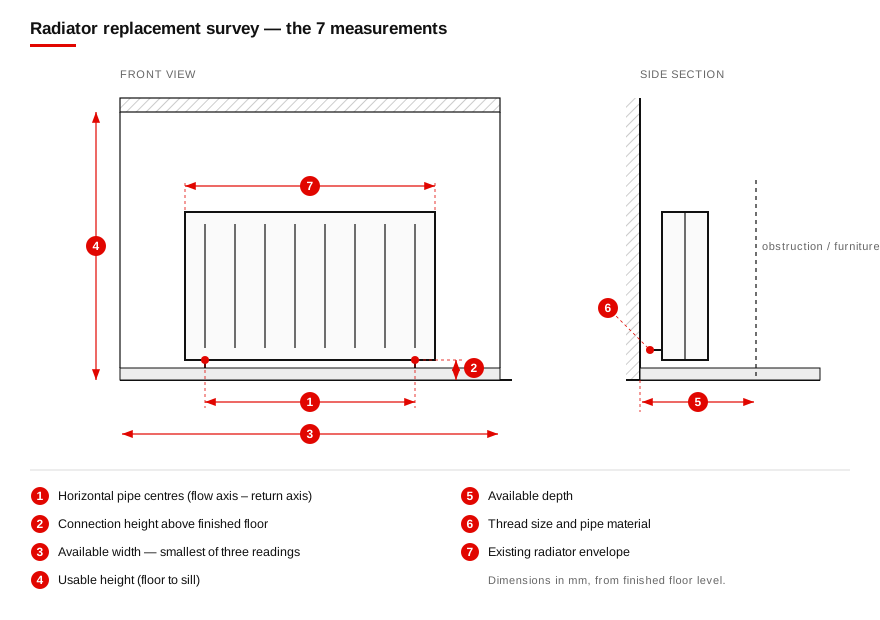
Take them on site, with the old radiator still in place. Five minutes here saves days later.
| # | Measurement | Why it matters |
|---|---|---|
| 1 | Horizontal pipe centres (flow axis to return axis) | The governing dimension. If it doesn't match, you are either chasing the wall or running exposed pipework |
| 2 | Connection height above finished floor level | Determines whether the new emitter can conceal the existing tails |
| 3 | Available width, measured at three points | Walls are never parallel — the smallest reading is the real one |
| 4 | Usable height (floor to sill, shelf or soffit) | Sets the true maximum height, not the catalogue one |
| 5 | Available depth (wall face to curtains, furniture, walkway) | A double tubular projects far more than a flat panel |
| 6 | Thread size and type (1/2", 3/4", male/female) and pipe material (copper, multilayer, steel) | Governs adaptors and compatibility |
| 7 | System configuration: two-pipe or single-pipe, TRV present or not | Single-pipe systems require specific valve types |
Practical tip: photograph the connections with a tape measure lying alongside them. It removes most of the misunderstandings that occur at quotation stage.
The declared output is not the output you will get
This is the costliest mistake, and it has nothing to do with geometry.
Radiator outputs are declared to EN 442, measured at delta T 50 K — mean water temperature 70 °C, room temperature 20 °C. If your system runs cooler, real output falls, and it does not fall linearly.
The relationship is exponential:
Q = Q₅₀ × (ΔT / 50)ⁿ — with n ≈ 1.3 for radiators
In practice:
| System condition | Delta T | Real output vs. declared |
|---|---|---|
| Conventional boiler 80/70 | 50 K | 100% |
| Condensing 65/55 | 40 K | ≈ 75% |
| Heat pump 55/45 | 30 K | ≈ 51% |
| Low temperature 45/35 | 20 K | ≈ 30% |
The figure that surprises nearly everyone: on a heat pump, a radiator delivers roughly half its catalogue output. A unit rated at 1,200 W becomes a 620 W unit in the actual room.
This does not make radiators incompatible with low-temperature systems. It means they must be resized, normally by increasing heat exchange surface: greater height, greater depth, more sections. Which is precisely where standard envelope sizes start running out.
When standard works, and when it doesn't
Not every job needs a bespoke emitter. A working rule:
Standard is fine when…
- existing pipe centres match a catalogue dimension, or fall within adaptor tolerance;
- the recess is regular, with 30–40 mm clearance each side;
- the system stays at high temperature and required output is unremarkable;
- there are no particular aesthetic constraints.
Made-to-measure earns its place when…
- pipe centres are non-standard and the alternative is builder's work;
- the space is narrow, tall, irregular or under a low sill;
- you need more surface within the same envelope to compensate for low flow temperatures;
- the emitter is visible in a designed interior and must follow finishes and colours;
- the building is listed or historic, where every chase is a consent issue as well as a cost.
The commercial arithmetic is less obvious than it looks: the price gap between a standard unit and a made-to-measure one is frequently smaller than the cost of chasing, making good, redecorating and the extra days on site.
Five recurring survey errors
- Measuring width at one point only. Walls converge; the radiator fits at the top and not at the bottom.
- Forgetting the skirting board. It takes 10–20 mm of depth and shifts the bracket datum.
- Comparing outputs without checking the delta T. Two datasheets can quote different reference conditions.
- Ignoring system flow rate. A substantially larger emitter may require rebalancing the circuit.
- Ordering before the site visit. A survey done from memory by the end client is the single most common cause of returns.
Frequently asked questions
What are the most common pipe centres on existing radiators?
It varies by era: older installations tend towards side connections with assorted centres, while recent units frequently use a middle connection at 50 mm. That variety is exactly why a point-by-point survey is unavoidable.
Can I keep the existing pipework when changing model?
Often yes, using adaptors within a few centimetres. Beyond that, you either open the wall or have the emitter built with connections in the existing position.
Do radiators work with heat pumps?
Yes, if sized for the real delta T. You need more exchange surface for the same required output: taller, deeper or more numerous elements.
How do I convert declared output to my system's delta T?
Use the exponent n ≈ 1.3 (see the table above). Reputable manufacturers already publish outputs at several delta T values in their datasheets.
Does colour affect output?
Negligibly for standard finishes. Position, shelving, radiator covers and any obstruction in front of the emitter matter far more.
Are TRVs the same on single-pipe systems?
No. Single-pipe systems need valves designed for that configuration; two-pipe valves are not interchangeable.
Before you order
Survey first, convert the output to your system's real delta T, then choose the product. If the dimensions you need don't exist in a catalogue, a compromise isn't the only route: an emitter can be built to the connection positions and envelope you actually have, frequently within the same price bracket.
PRO-SER is a commercial agency specialising in interior finishing — windows and doors, flooring, sun shading, architectural hardware, bathroom furnishing and radiant heating systems. It supports around 200 points of sale across north-western Italy and works with installers, retailers and specifiers from technical verification through to installation, including international projects.
Got a difficult survey? Send us your measurements and system conditions and we'll tell you whether a catalogue solution exists or whether building to size makes more sense.
👉 Read the full guide to custom heating and cooling systems

📄 Download the printable survey sheet (PDF, A4) — the seven measurements, the output correction table and the five errors that cause returns, on two pages you can take on site.
📋 Present your project: tell us your measurements and get guidance on the best fit solution